
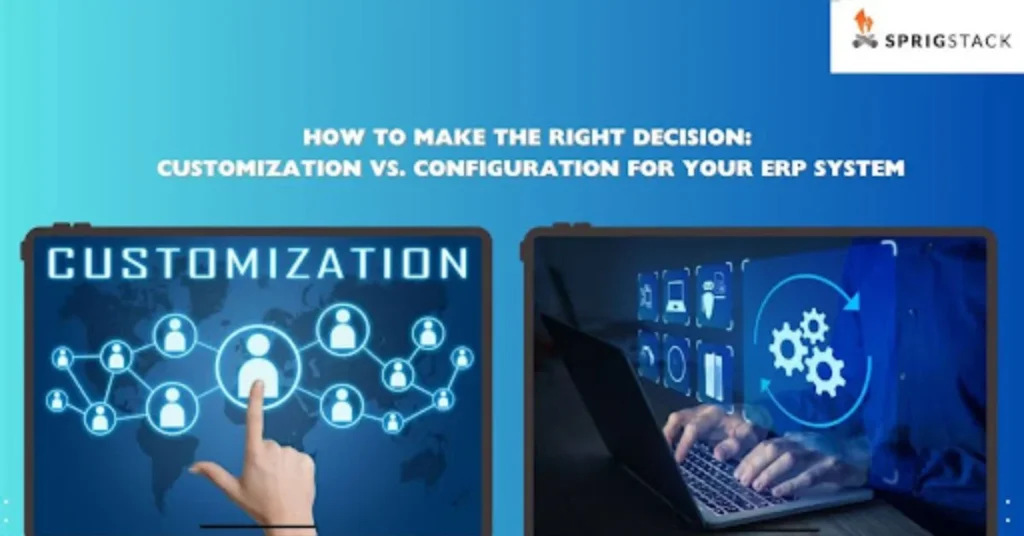
Enterprise Resource Planning (ERP) systems are essential for streamlining business operations, improving efficiency, and enhancing decision-making. However, when implementing an ERP system, businesses often face a critical choice: Should they customize the ERP or configure it to meet their needs?
Understanding the difference between customization and configuration is crucial for making the right decision. This article explores both approaches, their pros and cons, and helps you determine the best fit for your business.
What is ERP Configuration?
Configuration refers to adjusting the ERP system’s built-in settings to align with business processes without altering the underlying code. Most modern ERP solutions (like SAP, Oracle, Microsoft Dynamics) offer extensive configuration options.
Key Features of Configuration:
- Uses the ERP’s existing features and modules.
- No coding or software development required.
- Faster implementation with lower costs.
- Easier upgrades and maintenance.
When to Choose Configuration?
- Your business processes are standard and can fit within the ERP’s existing framework.
- You want a quicker, cost-effective implementation.
- You prefer easier future upgrades and vendor support.
Pros of Configuration:
✅ Lower cost and faster deployment
✅ Easier maintenance and upgrades
✅ Vendor-supported features
✅ Reduced risk of system instability
Cons of Configuration:
❌ Limited flexibility for unique business needs
❌ May require slight process adjustments
What is ERP Customization?
Customization involves modifying the ERP system’s code to tailor it to specific business requirements. This could include adding new features, changing workflows, or integrating with other software.
Key Features of Customization:
- Requires coding and software development.
- Highly flexible but more complex.
- Longer implementation time and higher costs.
- May complicate future upgrades.
When to Choose Customization?
- Your business has unique processes that the ERP doesn’t support out-of-the-box.
- You need deep integration with other proprietary systems.
- Competitive advantage depends on specialized functionality.
Pros of Customization:
✅ Perfect alignment with business needs
✅ Competitive edge with unique features
✅ Ability to automate highly specific workflows
Cons of Customization:
❌ Expensive and time-consuming
❌ Higher risk of bugs and system instability
❌ Upgrades may break custom features
❌ Requires ongoing developer support
Which One Should You Choose?
The best approach depends on your business needs:
| Factor | Configuration | Customization |
|---|---|---|
| Cost | Lower | Higher |
| Time | Faster | Slower |
| Flexibility | Limited | High |
| Maintenance | Easier | Complex |
| Upgrades | Smooth | Risky |
Best Practice:
- Start with configuration—modify business processes where possible.
- Customize only when necessary—for critical, unique requirements.
- Consider hybrid solutions—use add-ons or industry-specific modules before full customization.
FAQs on ERP Customization vs. Configuration
1. What’s the main difference between customization and configuration?
- Configuration adjusts existing ERP settings without coding.
- Customization modifies the ERP’s code to add or change functionality.
2. Is customization always better than configuration?
No. Customization is only better if your business has unique needs that can’t be met through configuration. Otherwise, configuration is safer and more cost-effective.
3. Does customization affect ERP upgrades?
Yes. Customizations may break during upgrades, requiring additional rework.
4. Can I switch from configuration to customization later?
Yes, but it’s best to plan ahead. Some configurations can be extended with minimal customization.
5. How do I know if my business needs customization?
Ask:
- Does the ERP lack a critical feature we need?
- Are we willing to handle higher costs and maintenance?
- Is there no industry-specific module available?
If “yes,” customization may be necessary.
6. Are there alternatives to full customization?
Yes! Consider:
- Third-party add-ons (e.g., from the ERP’s marketplace).
- Workflow automation tools (like Power Automate for Dynamics).
- Industry-specific ERP versions that may already include needed features.
7. How can I minimize risks with customization?
- Document all changes thoroughly.
- Work with experienced ERP developers.
- Test extensively before full deployment.
- Keep customizations modular for easier updates.
Conclusion
Choosing between ERP customization and configuration depends on your business’s unique needs, budget, and long-term IT strategy. While configuration is the safer, more cost-effective choice for most businesses, customization may be necessary for specialized workflows.
Before deciding, consult with ERP experts, evaluate your processes, and consider a phased approach—starting with configuration and adding customization only where essential.

